Показаны сообщения с ярлыком Russian Far East. Показать все сообщения

понедельник, 21 декабря 2009 г.

Amur River near Khabarovsk - ice-fishing for whitefish Coregonus ussuriensis

Amur whitefish Coregonus ussuriensis is one of two whitefish species which dwell in the huge Amur River drainage.  The fish can reach big size (up to 5 kg).  The ecology of the species is unique:  from September till April it can be found in the main channels of the Amur River.  In summer the water in Amur is too warm for whitefishes, up to +25*C.  For the summer this species is migrating upstream into the cool water of the lower parts of mountainous tributaries of the Amur R.  Most of its diet consists of small fish. 
 
Smooth ice is formed over shallow sandbars with slack current; broken ice shows the areas with the depth over 3 meters and strong current.  The fishermen are catching whitefish at the depths 3 to 5 meters. 


Typical tackle for Amur whitefish has a small brass lure with 2 hooks.  Above it we tie a dropper hook on a long tippet; this hook is baited with a long and narrow piece of raw fish. 


The lure is lifted from the bottom and dropped back every 2-4 seconds.  Most of the fish are caught not with the lure itself, but with a baited hook. 


When the biting is good, during the day it is possible to build a long fence


Arthur is glad to catch a nice Amur whitefish


 This species has terminal mouth, suitable to catch small fish


In 5 long months I will be able to catch similar fish with a flyrod..

среда, 16 декабря 2009 г.

Amur River - two streams in one


Amur is about 4350 kilometers (3000 miles) long; by the surface of the watershed drainage it is the tenth biggest river of the Globe. Lower reaches of Amur begin from the mouth of big right tributary, Ussury River. Here is situated the biggest city of the Russian Far East, Khabarovsk. For 400 km downstream from Khabarovsk Amur has low gradient and flows mostly on sand. Countless creeks and channels, pools and islands, lakes and sloughs form an enormous labyrinth, where it is easy to get lost.


The list of Amur fish contains more than 130 species; its fish community is still not well studied. This fauna is queer mixture of typical coldwater species (burbot), widely distributed northern salmonids (taimen), representatives of the temperate zone (carp), and true tropical fish as well (snakehead). Besides that, 3 species of Pacific salmon (pink, chum and cherry) enter the river for spawning. In summer the water in Amur is warm enough for fish from the tropical rivers to thrive. Coldwater species spend summer in mountains, in cool tributaries. In summer the main channel of the river and the floodplain water bodies are the kingdom of warm-water species. The water in the river can be 22-26ºC, and in shallow lakes - up to 32ºC! Salmonids and other fish which do not like warm water spend this unfavorable period in mountainous tributaries.

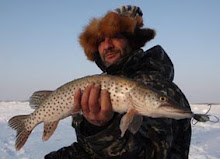
Many strange fish live in Amurr River - like this Amur pike

On the contrary, in winter and spring Amur is a typical Siberian river; it is covered with thick ice. Some fish are still active in freezing-cold water – Siberian taimen, lenok (Siverian trout), whitefish, some Carps (ide, barbel, blackbelly, etc.), burbot, and Amur pike.

All this means, that from the ecology point of view Amur is not one river, but at least two - with different fish faunas.

During the freezing Amur has strong ice-flood.  By mid November the river looks like a boundless fiels of broken ice.  Only slow channels and lakes are covered with normal, smooth ice.  is


In winter Amur River valley looks like a desert, covered with both ice and sand  


The entire Siberia is frozen from November till April or May