среда, 27 января 2010 г.

Ice fishing in the Sea of Okhotsk near Magadan

The winter in Magadan is not severe, but long - it lasts for 7 months.  Ice fishing in fresh water and in the Sea of Okhotsk is a passion for many local fishermen.  Here you can see the hichhikers in heavy winter clothes & boots, which try to catch a ride to the fishing places far from the banks of the Gertnera Bay near Magadan.  Sometime the best fishing is found 10-15 km by ice-road. 


This lone, 12 m tall cliff in the sea is called "Monk".  The fish is often biting on the depths of 12-18 meters around the cliff. The locals call this "fishing by the monk".


After a blizard there is plenty of wet snow on the ice.  The 2-wheel drive cars easily get stuck.  This driver is hurriedly working with a shovel - others guys are already catching fish!


Two main quarries of ice-fishermen in the Sea of Okhotsk - suffron cod (left) and rainbow smelt. 

My ice-fishing rod is 70-75 cm long and has wire hooks, on which I wrap the line when lifting the fish to the ice.  This allows to pull out 20-25 meter long lines without taking off heavy fur mittens.  The fish is caught with a series of little hooks baited with narrow strips of condom.  The best colors of these "flies" (marine plancton imitations) are pink and white.


When the fishermen see somebody catching fish, they come and drive to the area with a school of fish from all directions.  In a quarter of an hour lucky fisherman could be surrounded by hunreds of his collegues. 


Pacific cod in winter is caught mostly with big lures close to the bank

суббота, 16 января 2010 г.

Amur pike Esox reicherti - part 2

At the main channel of the Amur River near the Sarapulskoe village the pike fishermen make the holes along the banks, at the depth 1,5-3 m


When ice-fishing the most important is to find a trail, which the fish is using..


The most common pike lure for ice-fishing in the Amur River is called "crab"


This fish is often biting its prey from the head; this is why one hook in the tail is not enough


Rare catch through the ice - 2 catfish were caught among the pikes   


Amur catfish can be active in December, and bite pike lures


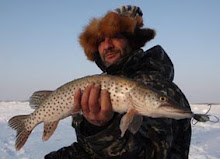
Trophy Amur pike


вторник, 12 января 2010 г.

Amur pike Esox reicherti

Amur River is frozen.  Huge river is covered with thick ice & snow from November till April. 


The fishermen is carefully approaching fresh ice of the river: this is his first ice-fishing in the season. 


This pike had swallowed a small whitefish, which was caught on a baited hook.  An unexpected, but valuable catch!


Nice size Amur pike is caught with a self-made "horizontal" lure, painted white. 


Local lure for ice-fishing for pike is called "crab".  This is not a snagging device: the fish is really biting it!


Some modern pike lures which were working on 2009


"Fire-tiger" is one of the colors which the pikes like


to be continued..


вторник, 29 декабря 2009 г.

Amur River, mid winter

In January the icefishing in the Amur River is not as good as from the "first ice" - in November.  Most of thefish are becoming sleepy and do not bite.  Thick ice makes it hard to search for the fish. 

Not far, at the right bank of Amur the busy city of Khabarovsk is waking up.  Near the low left bank the fishermen are preparing the holes for the whitefish fishing. 


Gas-powered ice-auger is rare tool on the ice of Amur.  Most of the local fishermen still prefer to use ancient ice-pikes.


When the ice is 1 m thick, it is hard work to break through it and make a hole. 


In mid December the schools of marine lamprey are coming to Khabarovsk from the Sea of Okhotsk (the distance is 900 km).  Lampreys will be spawning in May in the tributaries of the Amur River. 


The most active fish in January is burbot; it is both spawning and feeding eagerly.  


Burbot is the only freshwater cod


Amur pike is still biting, but not as active as in November & December. 


Amur pike is very pretty fish

четверг, 24 декабря 2009 г.

Sea of Okhotsk near Magadan - ice-fishing for rainbow smelt

Rainbow smelt Osmerus dentex mordax is a numerous anadromous fish of the North Pacific.  In winter it comes to the sea shores and feeds under the ice.  Magadan fishermen like to catch it both for fun and for food.  Smelt is very tasty if fried on oil. 

"Horseless" fishermen which do not have cars are trying to get a ride to the best fishing places, far into the Gertnera Bay near Magadan.


Gertnera Bay near Magadan is frozen.  By the sunrise all smelt-fanatics are already on the ice with their cars.  Looking for the schools of smelt, the fishermen sometimes get out as far as 5 km from the bank.


First bites, first smelts


After a snowstorm the snow on the sea ice is too deep for the trucks to go through.  On the first day after storm it is possible to move only on foot. 


To fish for smelt you need ice-auger, small scoop for ice, winter rod with lures, and something to sit on.  One can not fish out of a tent or shelter - the fish schools move fast, and fishermen have to follow.
Most of Magadan fishermen use custom-made stainless augers - salt water will destroy a normal auger quite fast.


Local smelt rigs in most cases look like garlands of tiny flies, imitations of marine plancton animals.  The best colors of the lures are light green, yellow, white, or pink.  The depth where we fish is normally between 15 & 25 meters.  The fish is most often found between 1 &4 meters from the bottom, but sometimes we catch it right below the ice.  My rod is 75 cm long and has wire hooks, which allow wrapping long line when lifting the fish to the ice.  This is much easier than pulling the line with the hands. 


This time I am fishing about 4 km from the nearest bank


If you are lucky to find a school, it is easy to catch several dozens of smelt in an hour. 


Rainbow smelt (Osmerus) - above
Pond smelt (Hypomesus) - below


The most common fish in winter catch near Magadan:
Saffron cod
Rainbow smelt
Pond smelt


среда, 23 декабря 2009 г.

Elgygytgyn Lake, Chukotka - Ice-fishing in mid June

Mysterious Elgygytgyn Lake has meteorite origin and the age about 3.5 million years. The lake is situated in Chukotka at 68*N, at the altitude of 500 m.  The lake very cold (1 - 3*C only) and deep (180 m). The water is extremely clear, with transparency up to 40 meters in spring, and 25 m in the fall. In the lake dwell 3 species of unique charrs, two of which are endemic species (see picture). These two charrs have got into the hands of scientists not long ago (1979 & 1985). They were described as species new for science, and one of them - as a new genera of salmonids (Salvethymus).

In beginning of July the lake is still covered with the ice, which is already partly melted.  On some years this ice is not melting till the next winter. 


Except the Elgygytgyn Lake, Boganid charr Salvelinus boganidae was found in some other lakes of Chukotka, and at the Taimyr peninsula (Central Siberia). In the lakes of Chukotka this fish can be over 10 kg. In the Elgygytgyn Lake Boganid charr is feeding mostly at the big depth. To digest the food, this fish is coming close to the lake shore or to the inlets of small creeks, where the water is several degrees warmer.


In June the lake is covered with the ice, but near the lake shores there is some open water.  I was catching Boganid charr both by spinning lures ...


... and through the ice with a "diving" lure. The ice in mid June is still strong enough to walk on it.  The biggest charr was 9.1 kg.   


Charrs of the Elgygytgyn Lake:
longfin charr Salvethymus svetovidovi - new genus
smallmouth charr Salvelinus elgyticus - new species
Boganid charr Salvelinus boganidae


Longfin charr (30 cm, 30+ years old male in spawning colors).  This species dwells most of the year on the depth of over 70 meters, and comes to the lake shores only sometimes.  It is very difficult to catch it with hook & line. 


Longfin charr is swimming in the hole in the ice. 


The lake outlet, the Enmyvaam River, is still murky from the snowmelt.  The river (rated 3) has some falls, and is flowing through canyons to the Anadyr River.

понедельник, 21 декабря 2009 г.

Amur River near Khabarovsk - ice-fishing for whitefish Coregonus ussuriensis

Amur whitefish Coregonus ussuriensis is one of two whitefish species which dwell in the huge Amur River drainage.  The fish can reach big size (up to 5 kg).  The ecology of the species is unique:  from September till April it can be found in the main channels of the Amur River.  In summer the water in Amur is too warm for whitefishes, up to +25*C.  For the summer this species is migrating upstream into the cool water of the lower parts of mountainous tributaries of the Amur R.  Most of its diet consists of small fish. 
 
Smooth ice is formed over shallow sandbars with slack current; broken ice shows the areas with the depth over 3 meters and strong current.  The fishermen are catching whitefish at the depths 3 to 5 meters. 


Typical tackle for Amur whitefish has a small brass lure with 2 hooks.  Above it we tie a dropper hook on a long tippet; this hook is baited with a long and narrow piece of raw fish. 


The lure is lifted from the bottom and dropped back every 2-4 seconds.  Most of the fish are caught not with the lure itself, but with a baited hook. 


When the biting is good, during the day it is possible to build a long fence


Arthur is glad to catch a nice Amur whitefish


 This species has terminal mouth, suitable to catch small fish


In 5 long months I will be able to catch similar fish with a flyrod..